

Protecting Your Sparkle: A Guide to Amazon AI, ACP, and UCP
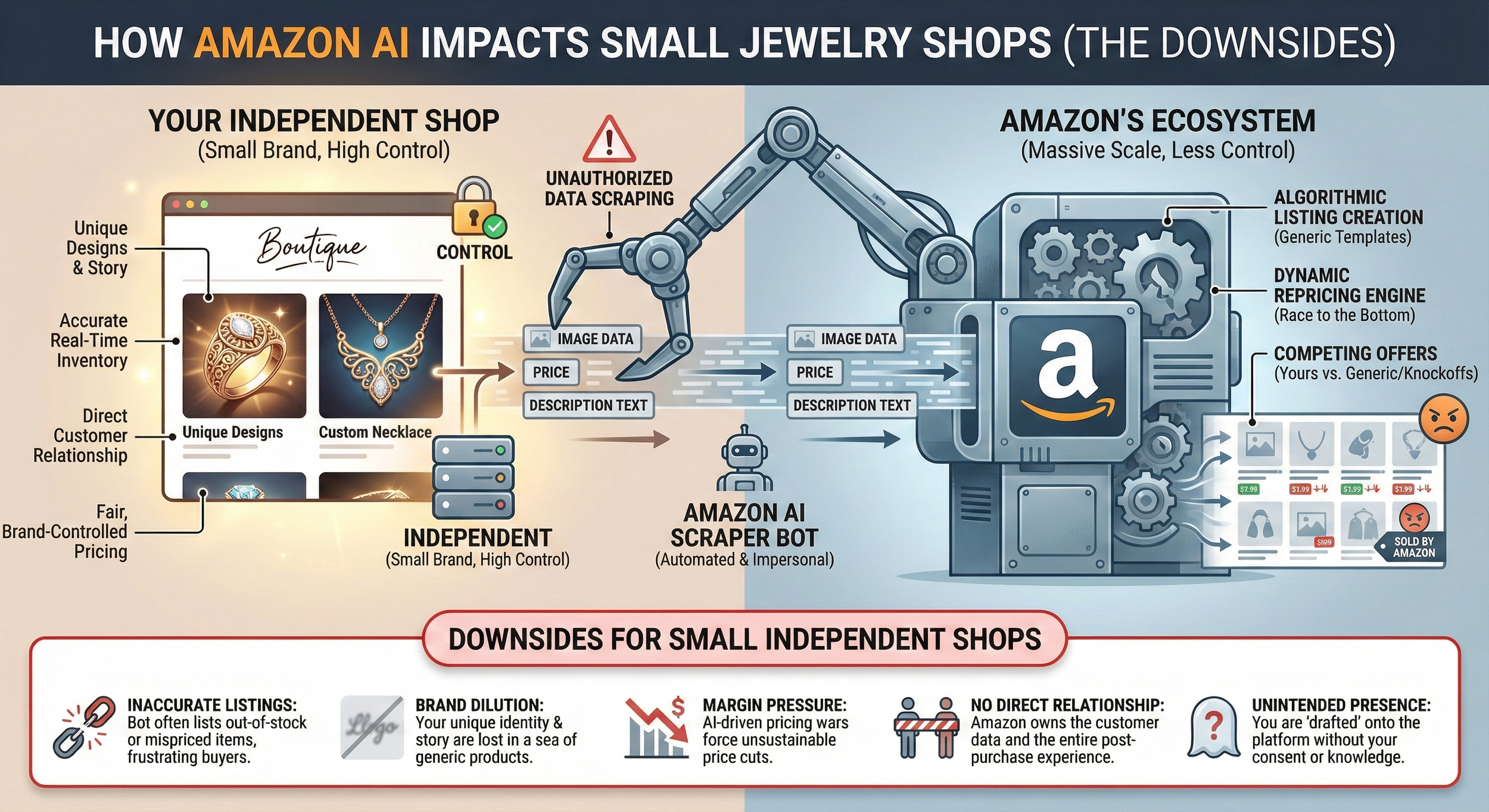
If you’ve been scrolling through designer forums lately, you’ve probably seen the headlines: “Amazon is selling my jewelry without my permission.” Between Amazon’s new AI shopping tools and all the chatter about ACP and UCP, it can feel like the internet changed overnight. [1]
Many designers are understandably lumping all of this together and worrying that the same technology powering new AI shopping tools is also behind Amazon’s scraping behavior. The reality is more nuanced: Amazon’s tools and open standards like ACP and UCP are very different, and the open standards are where your real opportunity lies. [2]
Let’s walk through what’s actually happening, why it matters for your jewelry brand, and how to tell the difference between the “back door” threat and the “front door” opportunity. But first, let’s give you a crash course on what agentic commerce (Amazon AI, ACP, UCP) is all about.
Imagine having a personal assistant who doesn't just remind you to buy milk, but actually knows which brand you like, checks which store has the best price, and goes out to buy it for you while you’re busy working.
In the world of online shopping, this is what we call Agentic Commerce.
The Shift: From "Searching" to "Deciding"
For the last 20 years, e-commerce has been about searching. A customer goes to a website, types in "gold hoop earrings," scrolls through pages of results, clicks a few, and eventually checks out. It’s a lot of manual work for the shopper.
Agentic Commerce flips this script. Instead of a customer doing the "heavy lifting," they use an AI Agent, a smart digital assistant, to do it for them.
The Customer’s Role: They state their goal (e.g., "Find me a pair of handmade gold hoops under $150 that can arrive by Friday").
The AI Agent’s Role: It "scours" the internet, talks to different stores, compares the options, and presents the perfect match. In many cases, it can even handle the payment and shipping details automatically.
Why This Matters for Your Jewelry Brand
As a small business owner, Agentic Commerce changes the "rules of the game." You are no longer just trying to catch a human's eye with a pretty photo; you are trying to make sure your store is "Agent-Ready."
If an AI assistant can't "read" your store or understand your inventory, it simply won't recommend you to the customer. This is why new technical standards are being created—to make sure small, independent creators don't get left behind by the big bots.
But here’s where it gets tricky: Not all AI "shopping" is created equal. Some big players are using this tech to take control away from you, while others are building "languages" to help you thrive. Now that you have that context, let’s get into a comprehensive discovery of the implications of each for your jewelry e-commerce stores.
1. The “Back Door”: Amazon’s AI Shopping Tool
Amazon has rolled out two programs that affect independent brands: “Shop Direct” and “Buy for Me.” These features can surface your publicly visible products in Amazon’s search experience even if you never chose to sell on Amazon. [3]
How it works: Amazon uses automated systems to read (scrape) public product pages on independent sites and use that data to power listings and recommendations in Amazon’s experience. [4]
The “Buy for Me” flow: When a shopper chooses your item inside Amazon’s experience, Amazon’s system then goes to your website and places an order on the shopper’s behalf, using your checkout as if it were a regular customer. [5]
Designers are upset because it feels like someone has taken a photo of your jewelry, listed it in their own shop, and only comes back to buy from you after they’ve already made the sale. In practice, this can cause mismatched prices, out‑of‑stock items being sold, and a complete loss of your carefully curated brand atmosphere.
The worst part is the misalignment of your brand as an independent retailer, selling out-of-date products that don’t represent your brand, creating confusion among shoppers, and ignoring the relationships you established with your loyal customers. Never mind that now your designs could be copied and sold for less.
The biggest sentiment, however, and rightly so, is that no one ever consented to Amazon doing this. As one creator said on Instagram -
“Innovation that ignores consent, is abusive”
From Amazon’s perspective, they’re using public product information unless merchants explicitly opt out, which is why some brands describe it as being “drafted” into a system they never signed up for.
You can test whether Amazon is doing this with your brand by going to Amazon and typing your brand into the search bar to see what comes up. I did this for my own jewelry brand, Andrea Li Designs, and this is what came up.
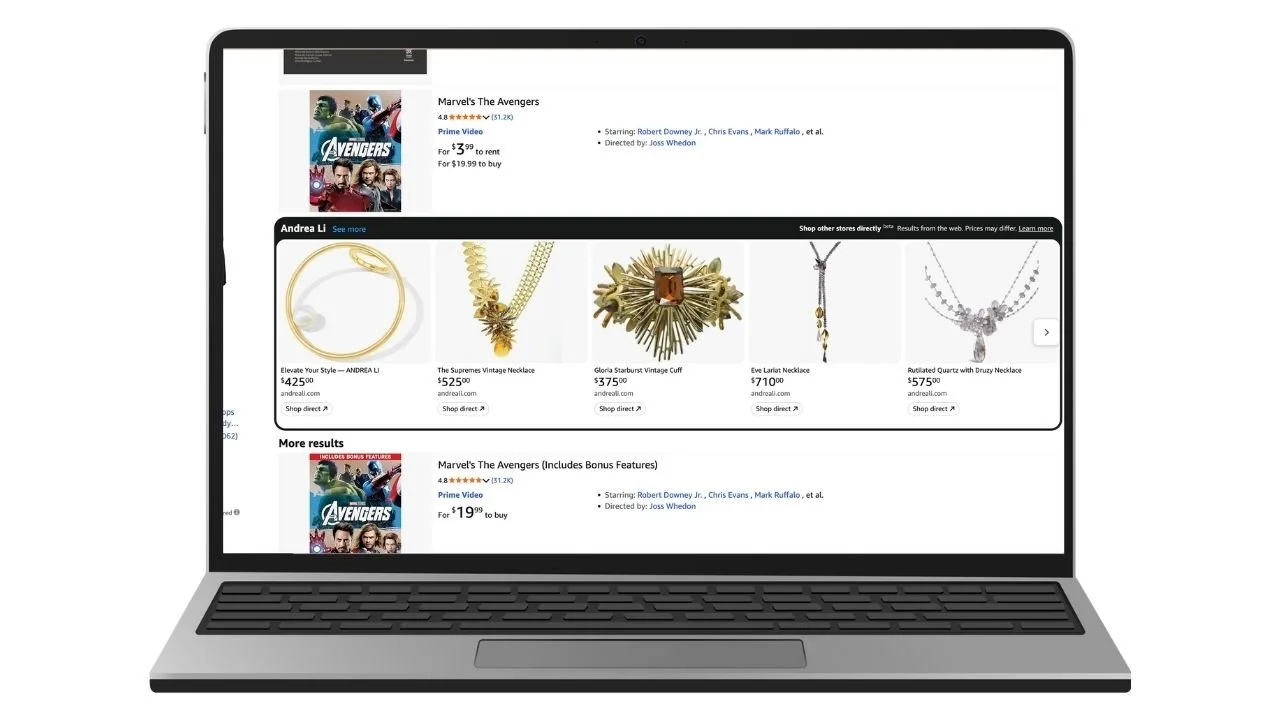
I ran quite a few keyword searches, such as ‘handmade gemstone jewelry’, ‘gemstone jewelry’, gemstone bracelets’, ‘gemstone necklace’, ‘pastel gemstone necklace’, ‘pastel gemstone jewelry’, ‘gemstone earrings’, to see if my brand surfaced with those descriptive queries. It did not.
What this tells me is that someone would need to search for your brand by name to see your products. As a one-of-a-kind designer, I’m less concerned with being copied than the designers who have production lines. Amazon AI, as intrusive as it is, is not tied to the controversy when multiple investigations (including a Wall Street Journal report and a U.S. House antitrust report) found that Amazon employees used detailed data on third‑party sellers’ best‑selling items to decide which products to copy or source and then sell under Amazon’s own brands, often at lower prices. [13]
The likelihood of my products being discovered on Amazon is quite low, given the expectations I have set with my audience to purchase through my website. My limited collections also don’t have the capability to ever be a ‘best-seller’. So, for me, this feature is rather benign, but I understand it is unacceptable to most creators and jewelry designers for the reasons cited above.
How to Spot Possible Amazon AI Shopping Activity (Without Becoming a Tech Person)
You don’t need to “prove” anything. You’re just looking for patterns that feel different from a normal customer order.
1) Check your orders for Amazon-looking email addresses
In your order list, scan the customer email field. If you see emails that include something like buyforme.amazon (or a similar Amazon-style domain), that can be a clue the order was placed through an Amazon-controlled flow.
What it looks like:
Customer email doesn’t look like a normal Gmail/Yahoo/business email
It looks “system-generated” or tied to Amazon
2) Watch for weird customer info that feels auto-filled
Sometimes these orders can include customer details that look… not human.
Clues to look for:
Names that are cut off, oddly formatted, or clearly not a real name
Addresses that look “perfectly formatted” but weirdly generic
Missing details a real person usually adds (apartment number, delivery notes, etc.)
Billing/shipping info that feels masked or unusual
You’re not judging the customer, you’re just noticing what’s out of pattern for your store.
3) Look for “too fast to be real” shopping behavior
This one is simple: if you have analytics (or even just your own intuition), watch for sessions that:
land on a product
add to cart
checkout
…all in a blink.
Most humans browse a bit. They scroll, click around, compare, hesitate. If it’s instant, that can be a signal.
What to do if you’re not using analytics: Just flag orders that feel like “how did they decide that fast?”, especially for higher-priced pieces.
4) If you have a tech helper, here are the “ask them to check” items
If you have a developer, Shopify expert, or someone who helps with your site (even a VA who’s tech-comfy), you can send them this list:
“Can you check if we’re seeing any traffic or orders tied to Amazon’s Buy For Me system?”
Specifically:
“Do you see anything labeled AmazonBuyForMe in traffic logs?”
“Do we have repeated visits that look automated?”
“Are there lots of hits coming from Amazon-owned networks/IPs?”
(You don’t need to understand what those mean; this is a copy/paste request to send to your developer)
Quick “Red Pin Geek” rule of thumb
If you notice two or more of these at the same time (weird email + odd customer data + lightning-fast checkout), treat it as a “worth confirming” order:
send a polite confirmation message
double-check sizing/lead time
document what you’re seeing (screenshots)

2. The “Front Door”: ACP (Agentic Commerce Protocol)
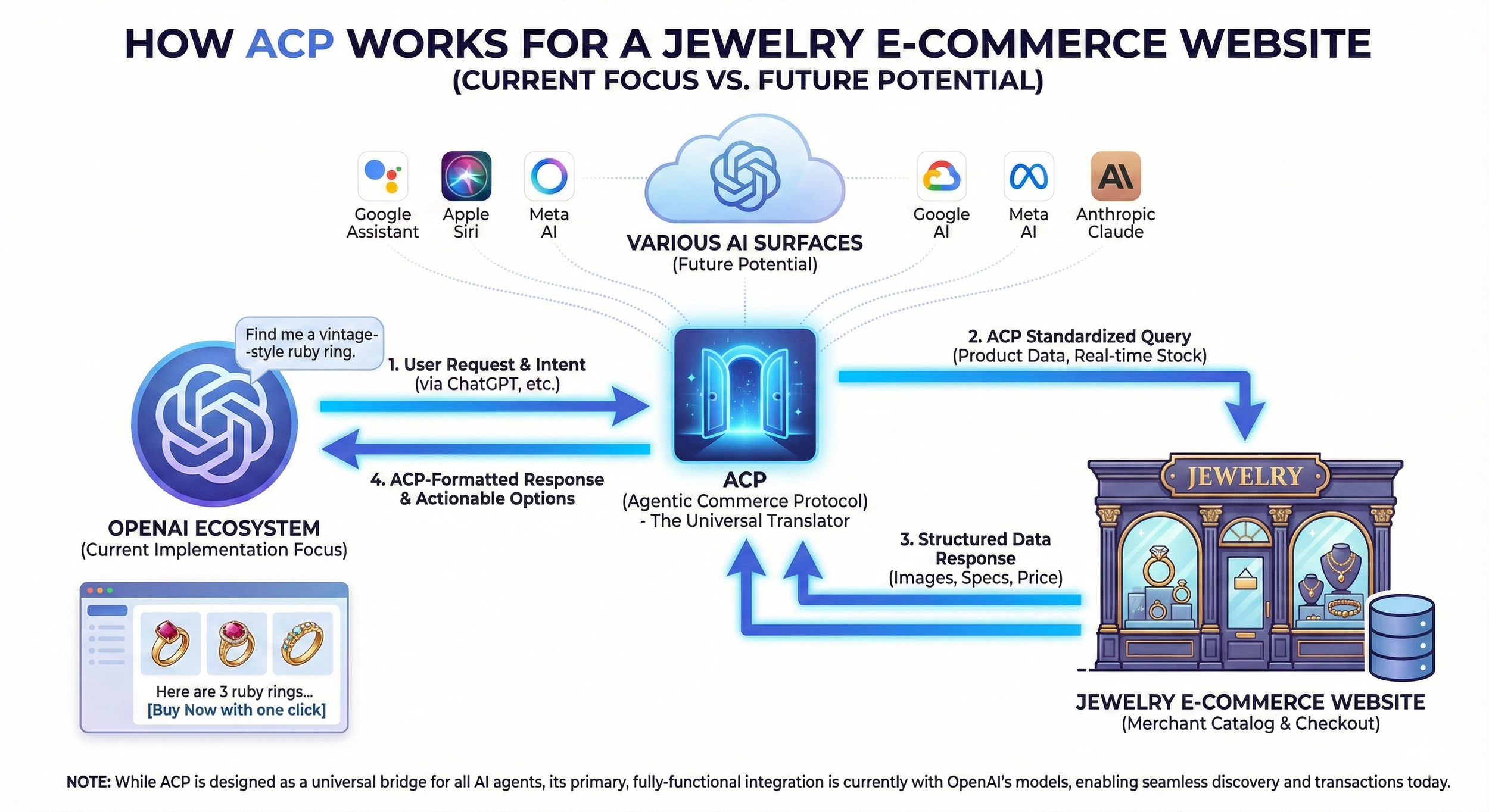
Now, let’s contrast that with ACP. Instead of guessing what’s on your site by scraping, ACP is a shared “commerce language” that lets AI assistants talk to your store through an official, structured connection. [6]
What it is: The Agentic Commerce Protocol (ACP) is an open standard originally championed by OpenAI to power “Instant Checkout” in ChatGPT and other agents. It’s not a proprietary Shopify feature, but Shopify integrates with it so your store can participate. [7]
Who it’s for: Right now, ACP is most visible inside ChatGPT and related AI assistants, with the protocol designed to be reusable by other agents as the ecosystem grows. [8]
What it does: Instead of an AI trying to interpret your pages from the outside, ACP lets an assistant ask your store directly for live product, price, and availability information, and then place a checkout where you remain the merchant of record. [9]
Here is a screenshot of the email Shopify sent to its merchants announcing the rollout of ACP.
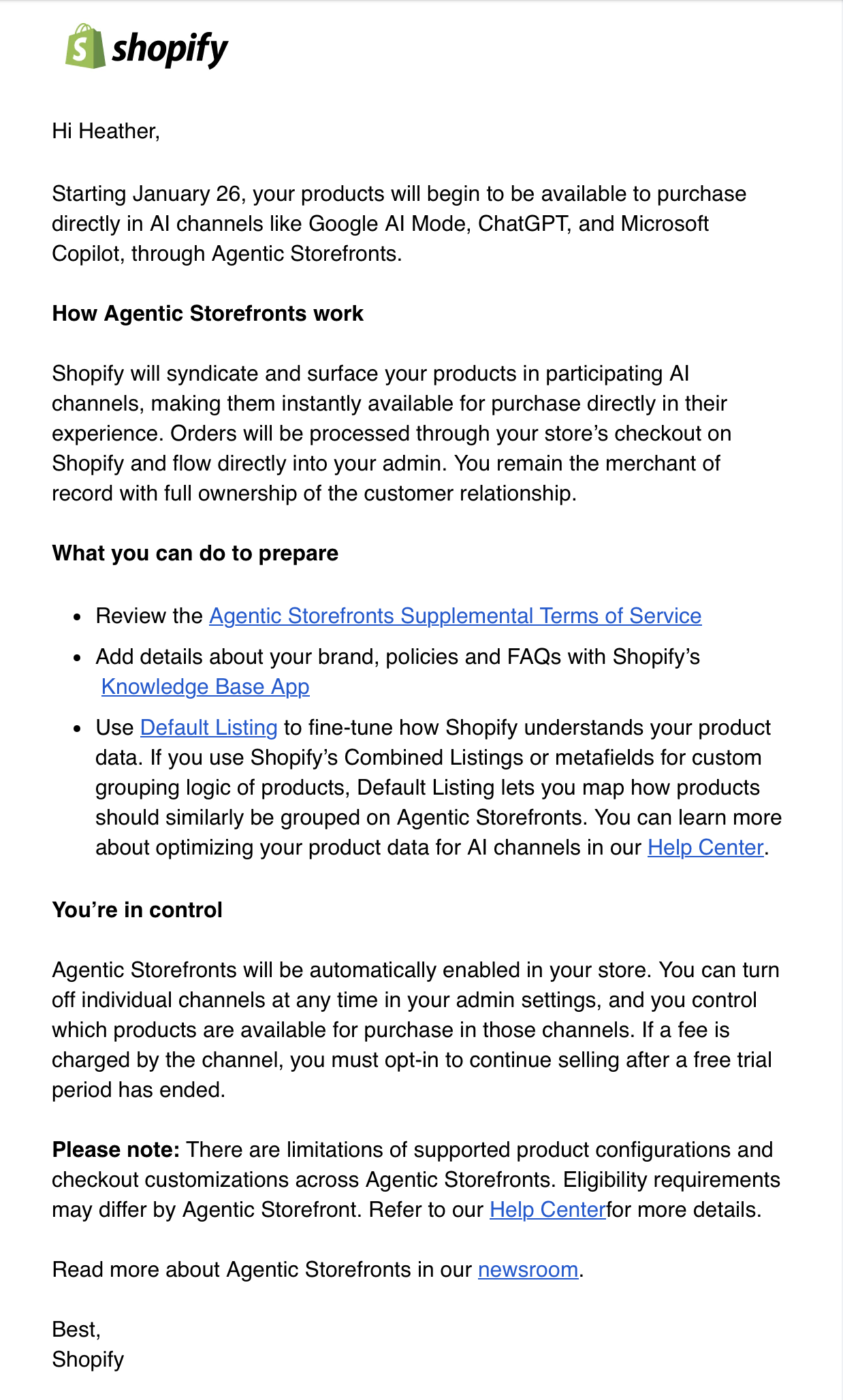
Let’s pause here for a moment to quickly explain what the heck ‘open standard’ is. Open Standard is essentially a "universal language" or a "common set of rules" that allows different technologies to talk to each other perfectly, regardless of who made them.
Think of it like a standard electrical outlet. Because the shape of the plug and the voltage are an "open standard," you can buy a lamp from one company, a toaster from another, and a vacuum from a third, and they will all work in your house without you needing a special adapter for every single one. Okay, back to your regular programming.
So a shopper could say to an AI assistant, “Find me a gold filigree necklace from an independent designer,” and the assistant can use ACP to discover compatible stores, check real inventory and pricing, and help complete the purchase securely. You control whether to integrate, which catalog data to expose (which products you want to make available to agents), and how the checkout behaves. [10]
3. The “Global Highway”: UCP (Universal Commerce Protocol)
UCP takes the same idea and tries to scale it beyond any single assistant or platform. Google is leading the push for the Universal Commerce Protocol as a standard way for retailers to connect to AI‑driven experiences across its ecosystem and beyond. [11]
What it is: UCP is a universal, open protocol for connecting commerce systems to AI assistants, starting with Google’s AI Mode in Search and the Gemini app, and is designed to extend to other experiences over time. [12]
How it differs from ACP: If ACP is a dedicated lane that lets ChatGPT talk to your store, UCP is more like a multi‑lane highway, built so many different assistants and AI entry points can use the same structured signals to understand your catalog, promotions, and order flows.
What it covers: UCP is designed to support the full journey: product discovery, promotions and discounts, order creation and updates, and native checkout via methods like Google Pay (with additional payment options planned), all while you stay the merchant of record. [13] When you "stay" the Merchant of Record, it means that even if a customer finds your jewelry through a futuristic AI bot or a giant marketplace, you are the one who technically sold it to them, not the middleman.
The key nuance: UCP is an open standard that can be implemented in many places; Google’s surfaces are the first high‑profile implementations, but are not on “every AI surface” yet.
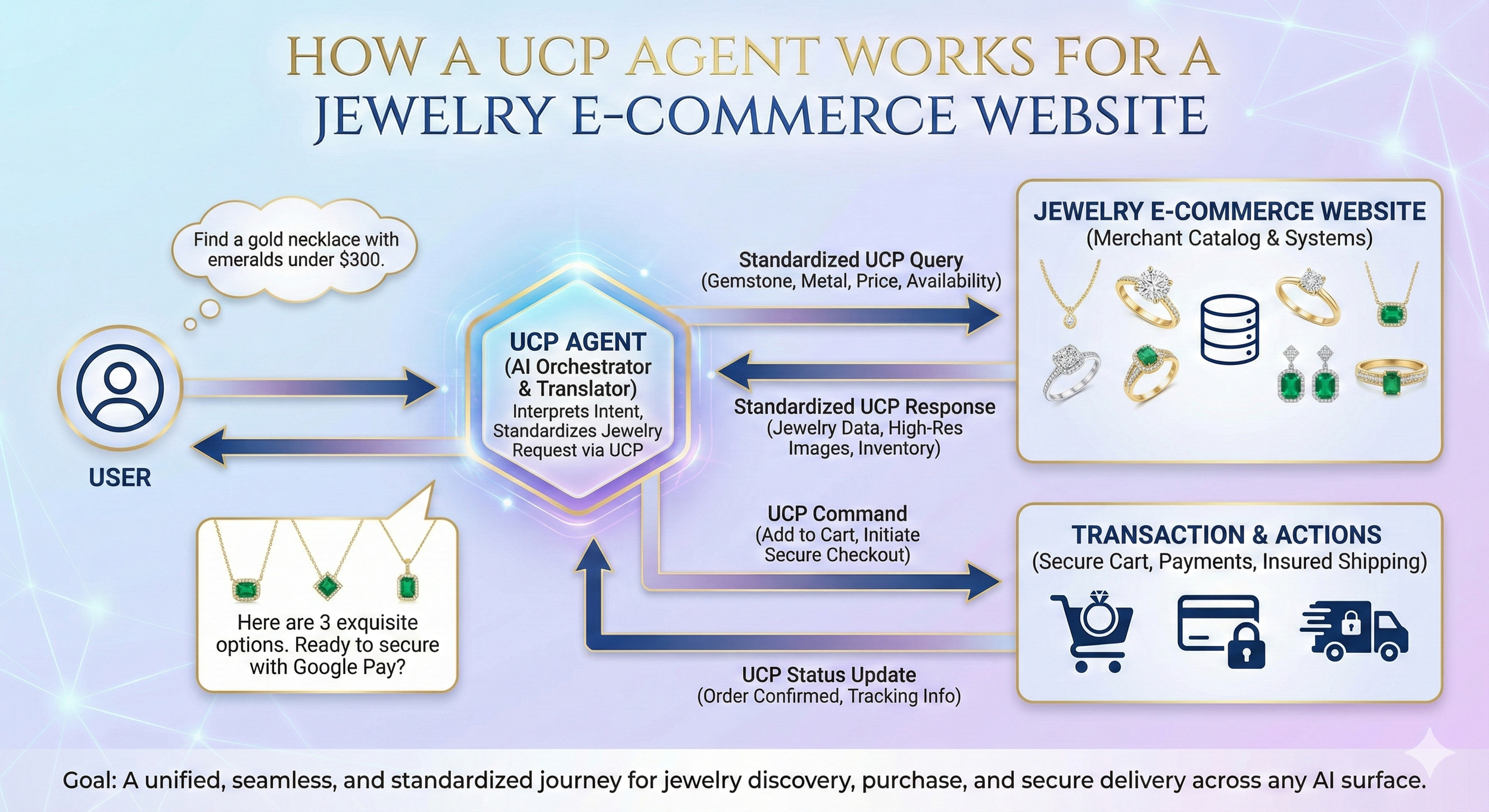
Google’s Next Move: How Agentic Commerce Will Transform Your Jewelry Business
If the Universal Commerce Protocol (UCP) is the "highway" that lets AI understand your store, Google’s latest suite of tools represents the high-end boutiques being built along that road. For a jewelry designer, these updates represent a shift from being "findable" to being "shoppable" in places you never thought possible.
Google is moving beyond simple search results and into Agentic Commerce, a world where AI doesn't just show a picture of your necklace, but helps the customer buy it, answers their questions about the clasp, and offers them a specialized deal to close the sale.
Checkouts in AI Mode: Removing the Friction from "I Love It"
The biggest hurdle for independent designers is often the "checkout drop-off." A customer sees your work on social media or in a search, but the journey to your website, adding to cart, and entering shipping info provides dozens of opportunities to get distracted.
Checkouts in AI Mode changes that. When a shopper is researching "handcrafted sapphire engagement rings" in Gemini or Google Search, they can now complete the purchase directly within the AI interface. [13]
The Benefit for You: You remain the Merchant of Record. This is crucial. Unlike the Amazon "Back Door" approach, you keep the customer relationship, the order data, and the brand credit.
The Experience: By using payment methods already saved in Google Wallet, the shopper can go from "discovery" to "purchased" in seconds, ensuring that the emotional connection to your jewelry isn't lost in a clunky checkout process.
Connect with Customers Using a Branded AI Agent
Jewelry is one of the most personal purchases a person can make. Shoppers want to know the story of the stone, the inspiration behind the setting, and the ethics of the sourcing. Usually, this requires you to be available 24/7 for DMs or emails.
Google’s new Business Agent acts as your digital "Virtual Sales Associate." Unlike a generic chatbot, you can train this agent in your specific brand voice. [14]
Personality Matters: You can teach your agent to explain your unique "sparkle" and craftsmanship just as you would at an in-person trunk show.
Deep Knowledge: It can answer technical questions, like the difference between 14k and 18k gold for a specific design, and guide customers through your collections based on their tastes, all while you’re back at the bench creating.
Introducing Direct Offers: The Right Sparkle at the Right Time
Sometimes, a customer just needs a small "nudge" to commit to a high-ticket heirloom piece. Direct Offers is a new pilot program within Google Ads that allows you to present exclusive, real-time incentives to shoppers who are clearly ready to buy. [15]
Instead of a generic site-wide sale, Google’s AI identifies "high-intent" shoppers, people who have spent time asking about your specific styles or comparing your pieces.
Smart Incentives: You can set parameters to offer a specific discount (like 15% off) or a value-add (like free insured shipping) directly within the AI conversation.
Protecting Your Margins: Because these offers are dynamic and targeted, you aren't devaluing your brand with permanent "on-sale" tags; you’re simply giving a personalized "thank you" to a customer who is on the verge of joining your brand family.
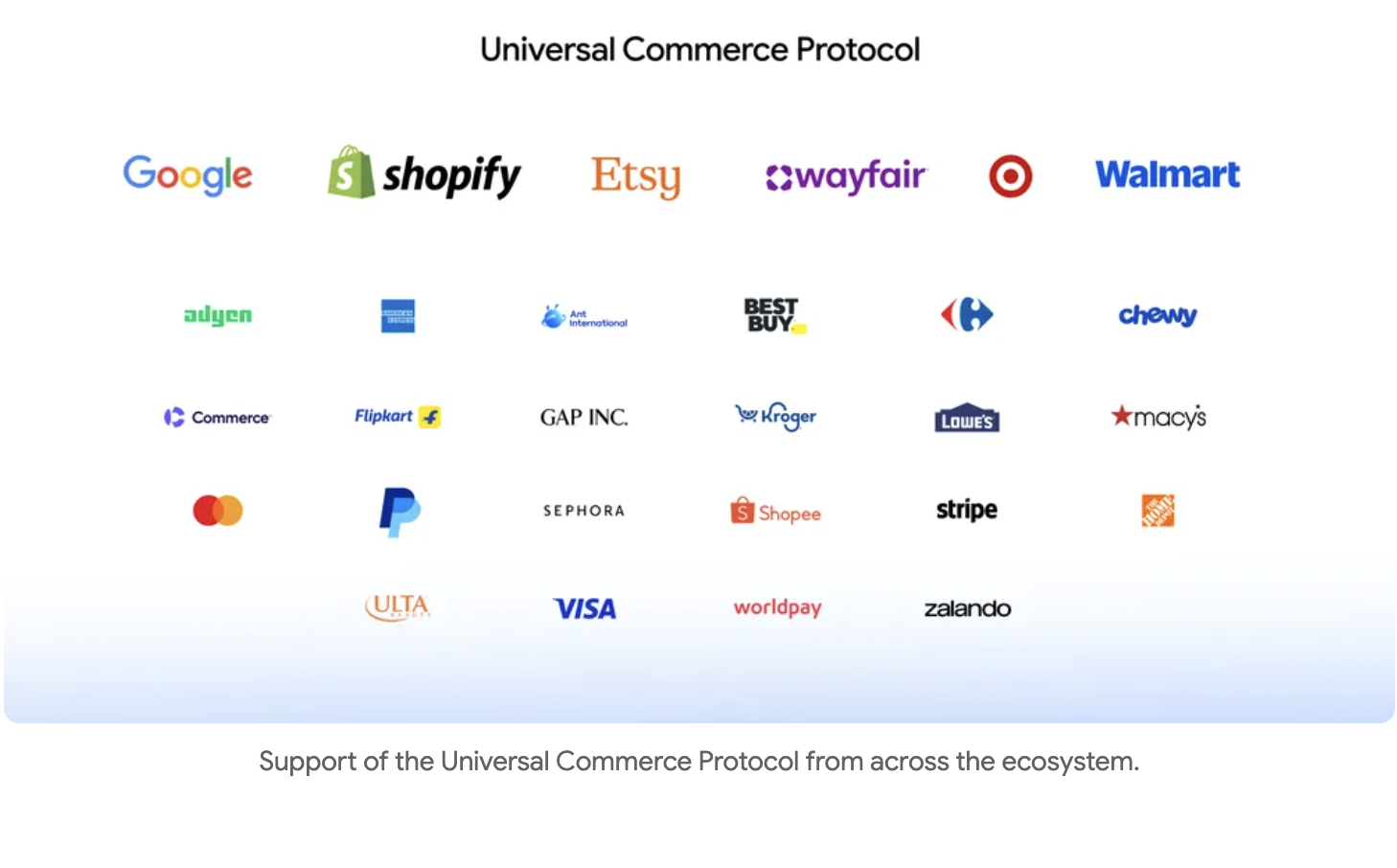
Here is a current list of merchants who support UCP:
The Bottom Line for Designers
The future of jewelry e-commerce isn't about fighting the bots; it's about claiming your space in the ecosystem. By leveraging these tools, you ensure that when an AI agent is looking for the perfect "one-of-a-kind gift," it doesn't just find your brand; it has everything it needs to complete the sale for you.
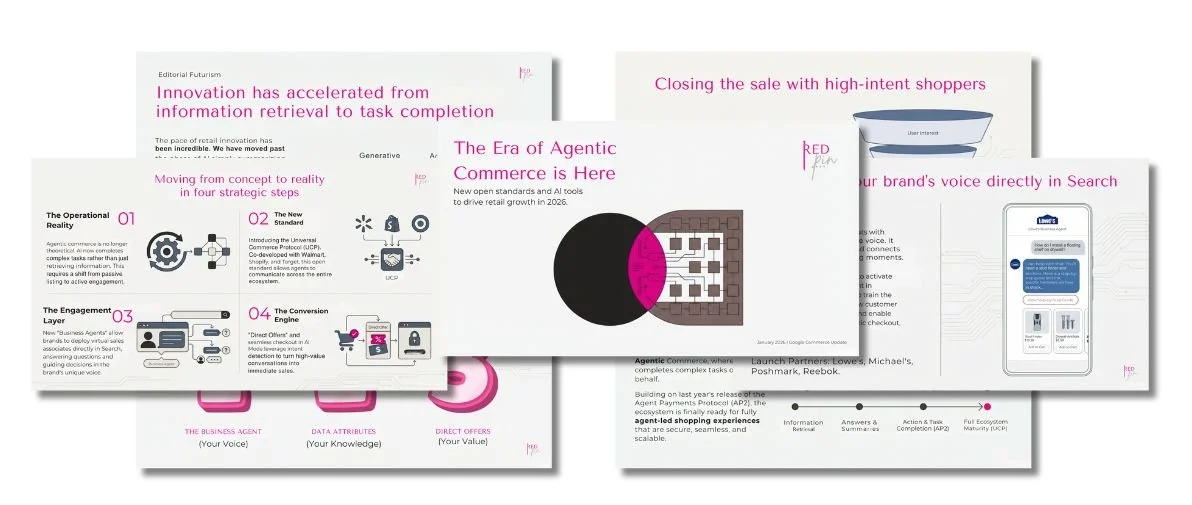
A comprehensive PDF download for Agentic Retail Commerce Growth 2026
ACP vs UCP vs Amazon: A Nuanced Cheat Sheet
Here’s a clearer way to compare the “back door” approach with the emerging “front door” standards.
| Feature | Amazon AI (the back door) | ACP & UCP (the front‑door standards) |
|---|---|---|
| Permission | Uses your publicly visible product pages unless you explicitly opt out via Amazon’s channels. | You opt in by integrating; your store only participates if you choose to implement the protocol. |
| Data source | Scrapes or reads your public pages and tries to infer products, prices, and stock. | Pulls structured, live data directly from your backend or connected feeds using a defined schema. |
| Accuracy | Real‑world reports show mismatches and outdated info can appear, even as Amazon says it checks stock and price. | Designed for much higher accuracy because assistants query live, merchant‑controlled data, though no system is literally perfect. |
| Customer data | Amazon controls the primary shopping interface and keeps the direct customer relationship for the Amazon experience. | You remain merchant of record and keep the core customer relationship, within the usual privacy and payment‑provider rules. |
| Control | You are effectively enrolled by default if your products are public, then must ask to be removed. | You manage when and how you participate, what catalog data is exposed, and how checkout flows are handled. |
5. Why This Can Be Good News for Your Brand
It’s tempting to want to shut everything down and avoid AI altogether, but opting into structured standards like ACP and UCP can actually strengthen your position.
Future‑proofing your visibility: As shoppers ask assistants like ChatGPT or Gemini for gift ideas or specific jewelry styles, ACP and UCP give those assistants a clean, accurate way to understand your catalog and present it correctly.
Less friction at checkout: Native or low‑friction checkout flows inside AI surfaces (while you remain the merchant of record) reduce hops and can help lower abandonment.
Better accuracy and fewer surprises: Because the protocols are designed to use structured, live data, there’s a much lower risk of someone buying an out‑of‑date price or an out‑of‑stock item than with an external scraper guessing from your website copy.
In other words, ACP and UCP are not part of Amazon’s scraping problem; they are a path to a more consent‑based, accurate version of AI commerce that works with you instead of around you.
6. How to Protect Your Store Right Now
While ACP and UCP are about building a healthy “front door,” you still need to secure the “back door” today. That means limiting unwanted bot traffic, using opt‑out channels offered by Amazon, and automating how your store handles suspicious agent‑placed orders.
Because most jewelry designers would rather be at the bench than inside a code editor, you can use a specialized tool to streamline that work, blocking Amazon’s bots where possible and using their official opt‑out process instead of doing everything manually.
ScrapeShield for Jewelers is a specialized cybersecurity toolkit and educational platform designed to help independent jewelry designers protect their unique designs from automated web scrapers and aggressive retail programs (like Amazon's "Shop Direct" or "Buy for Me" bots).
Key Features:
3-Phase Defensive Strategy:
Ask Politely: Technical instructions for updating robots.txt files to signal bots to stay away.
Official Action: Direct links and email templates to officially opt out of scraping programs via Amazon's Brand Registry and legal channels.
Lock the Door: Advanced technical shielding methods, including firewalls, bot detection apps, and Cloudflare configuration.
Platform-Specific Guides: Tailored step-by-step instructions for major e-commerce platforms, including Shopify, WooCommerce, Wix, Squarespace, and BigCommerce.
Domain Personalization: A feature that allows users to enter their website URL to automatically customize code snippets and email templates, making implementation faster and error-free.
AI Shield Assistant: An integrated expert consultant powered by Gemini 3 Pro that provides real-time, personalized answers to complex security questions (limited to 10 questions per session to ensure resource availability).
Resource Library: A curated collection of external links to the U.S. Copyright Office, WIPO fashion protection strategies, and advanced bot detection articles.
In short, it bridges the gap between creative design and technical security, giving jewelry designers the tools they need to keep their intellectual property off of mass-market platforms without their consent.
👉 Use the Amazon Scrape Shield for Jewelry Designers here: https://www.redpingeek.com/amazon-scrape-shield-for-jewelry-designers
The world of “agentic commerce” is arriving fast; your goal is not to fight every AI agent, but to close the uninvited back doors and open the front doors that let your brand shine on your terms. [14]
Frequently Asked Questions
What are ACP and UCP and why should jewelry designers care?
Is Amazon using AI to compete with independent jewelry stores?
How do I protect my jewelry brand from unauthorized AI scraping?
Want Red Pin Geek in Your AI Answers?
Google now lets you choose preferred sources that get labeled in AI Overviews and AI Mode. If this content helps you navigate AI visibility for your jewelry business, add us and you'll spot our links faster next time Google answers your questions.
Add Red Pin Geek as a Preferred SourceTakes one click. Works in Google Search, AI Overviews, and AI Mode.