

The Post-Click Growth Architecture™
Resource Hub
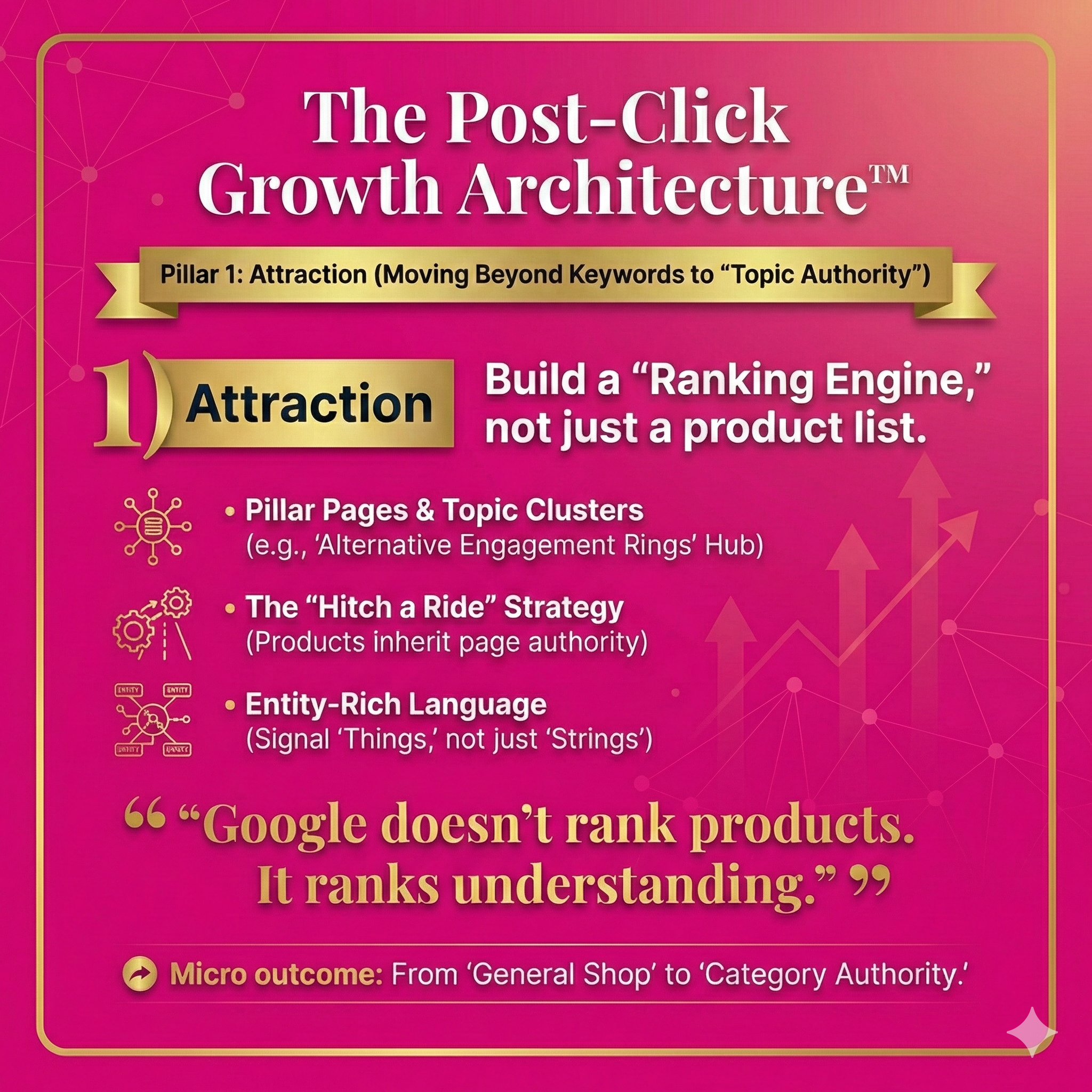
Pillar 1: Attraction
Moving Beyond Keywords to “Topic Authority”
For years, “good SEO” meant picking a keyword, writing a page, and hoping Google connected the dots. But AI Overviews (and modern search) don’t reward scattered pages; they reward brands that feel like the safest source to quote because their expertise is clear, connected, and complete.
Attraction, inside The Post-Click Growth Architecture™, is where you stop optimizing for phrases and start optimizing for understanding: you build one strong pillar page (your “display case”) and surround it with spokes, FAQs, comparisons, care guides, and “next-question” content, so engines can confidently summarize what you do, who you serve, and why you’re credible.
Key Insight: You don’t need to publish nonstop. You need coverage + clarity, clean headings, skimmable sections, definition blocks, and internal links that connect ideas, so your site reads like a guided collection rather than a random pile of posts.
👉 READ THE DEEP DIVE: Topic Authority: The Art of Attraction and SEO Strategy
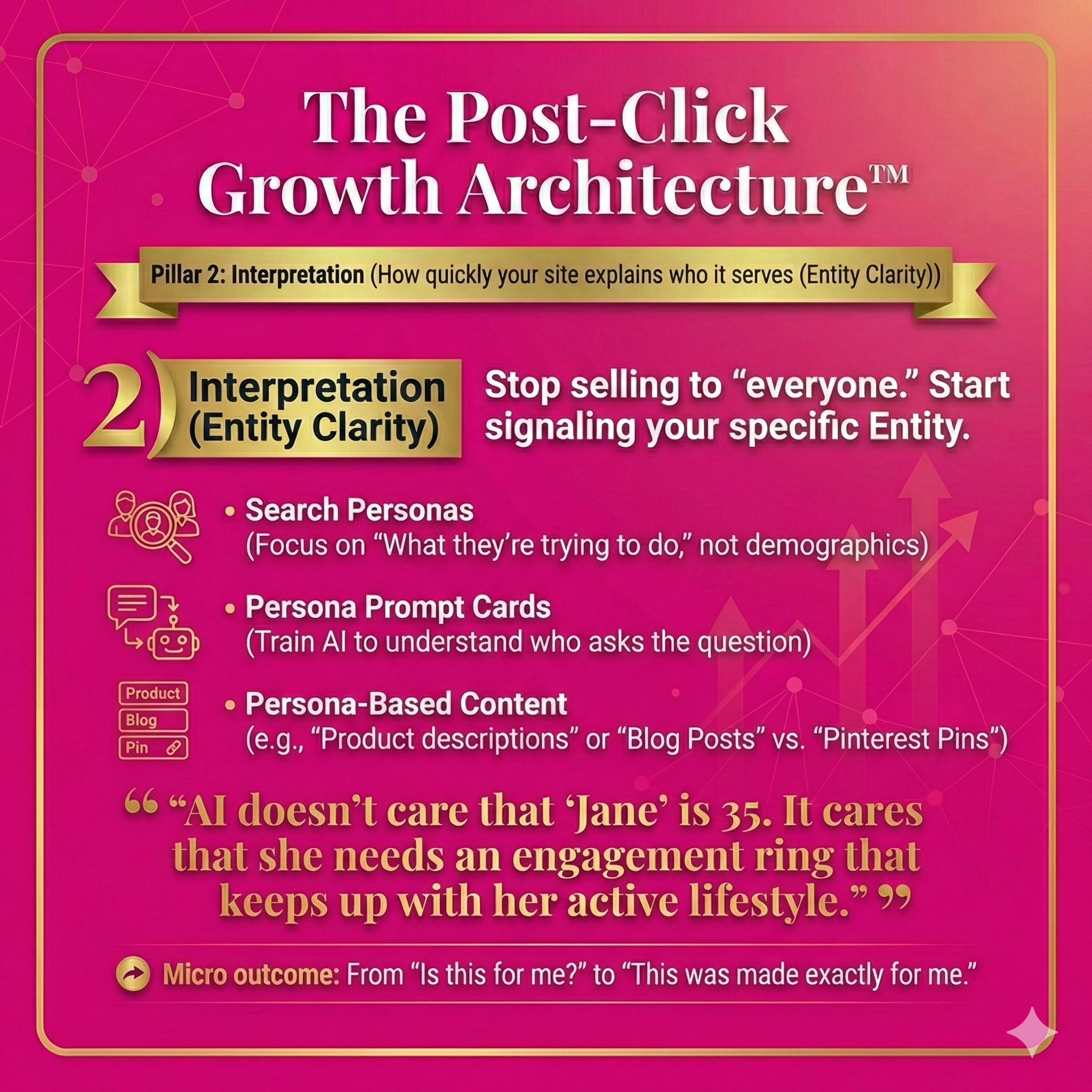
Pillar 2: Interpretation
Entity Clarity: How Quickly Your Site Explains Who It Serves
Most websites lose the sale after the click because they don’t answer the buyer’s silent question fast enough: “Is this for me?” Interpretation is the pillar where your site becomes instantly readable, by humans and AI, because it clearly signals who you serve, what they’re trying to do, and what makes your brand the “safe” choice.
That’s why AI-search personas matter: they don’t just describe a customer, they describe how that customer asks, what they ask next, and what kind of answer feels trustworthy inside ChatGPT/AI Overviews. When you build pages around those patterns (scenes, constraints, hesitations, trust triggers, and real query language), your site gains two wins at once: AI can confidently surface you, and shoppers hesitate less because the page answers questions in the right order.
Key Insight: You don’t need prettier personas. You need a persona-to-workflow loop that changes your headings, page structure, and copy so the right buyer recognizes themselves in seconds, and AI can clearly classify what you do and who it’s for.
👉 READ THE DEEP DIVE: Personas Are Your AI Visibility + Sales Clarity System
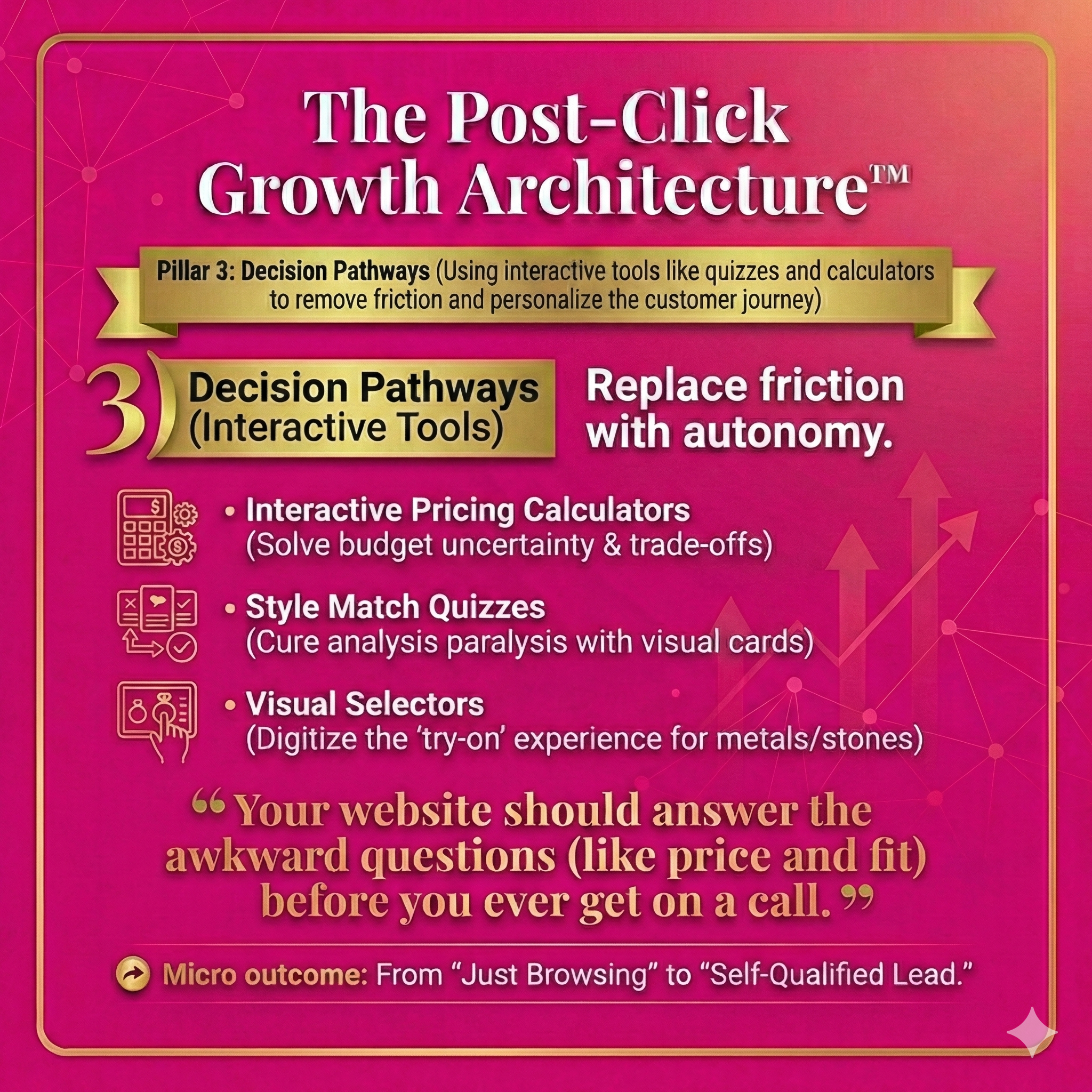
Pillar 3: Decision Pathway
Personalized “Next Steps” that Remove Friction
For high-consideration purchases (like jewelry), shoppers don’t just browse; they compare, second-guess, try to visualize, and worry about price. Decision Pathways are how your site stops being a gallery and starts acting like a digital concierge: quizzes, calculators, and selectors help visitors self-qualify, get clarity fast, and confidently choose what to do next, without feeling pressured.
The visibility win is real, too. Interactive tools don’t just “engage”, they turn your expertise into structured workflows (steps, tradeoffs, outputs) that keep people clicking deeper, earn backlinks because they’re harder to copy, and create clean “answer chunks” AI systems can extract and reuse.
Key Insight: A tool becomes a growth engine when it’s treated like an SEO asset, not a widget, built around a real buyer stall point (price uncertainty, analysis paralysis, preference confusion) and connected into your hub-and-spoke content so both humans and AI can follow the logic.
Pillar 4: Conversion Systems
Capture Intent. Don’t Demand a Sale
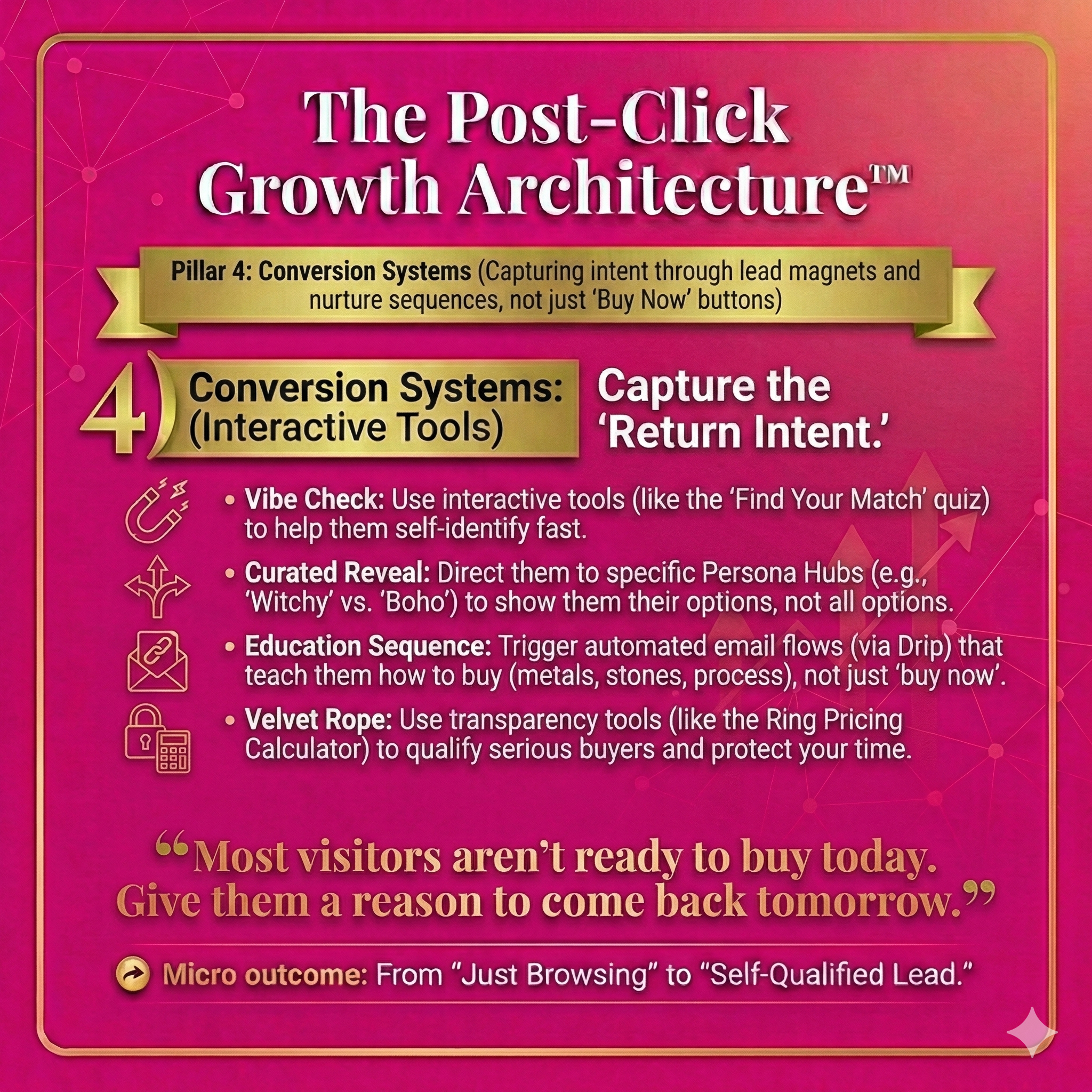
Most brands wonder why they don’t convert sales. It’s not the traffic that is the problem; the post-click experience is. People arrive curious, cautious, and overwhelmed… and a “Buy Now” button can’t do the job of reassurance, education, and timing. Pillar 4 is about building a real conversion system that captures interest early (even when someone isn’t ready today) and nurtures them into readiness with the right next step.
Inside the Digital Concierge model, this looks like: a high-intent opt-in (a guide, quiz, sizing/care cheat sheet, style match, etc.) that collects both email + preference data, followed by an education sequence that answers the exact questions that stall buyers, without screaming BUY NOW. It’s how “just looking” becomes “I trust you.”
Key Insight: The best conversion systems do two jobs at once: they turn traffic into owned demand (lead capture + lifecycle email), and they create the kind of structured, trust-building clarity that makes both humans and search/AI systems understand your brand faster.
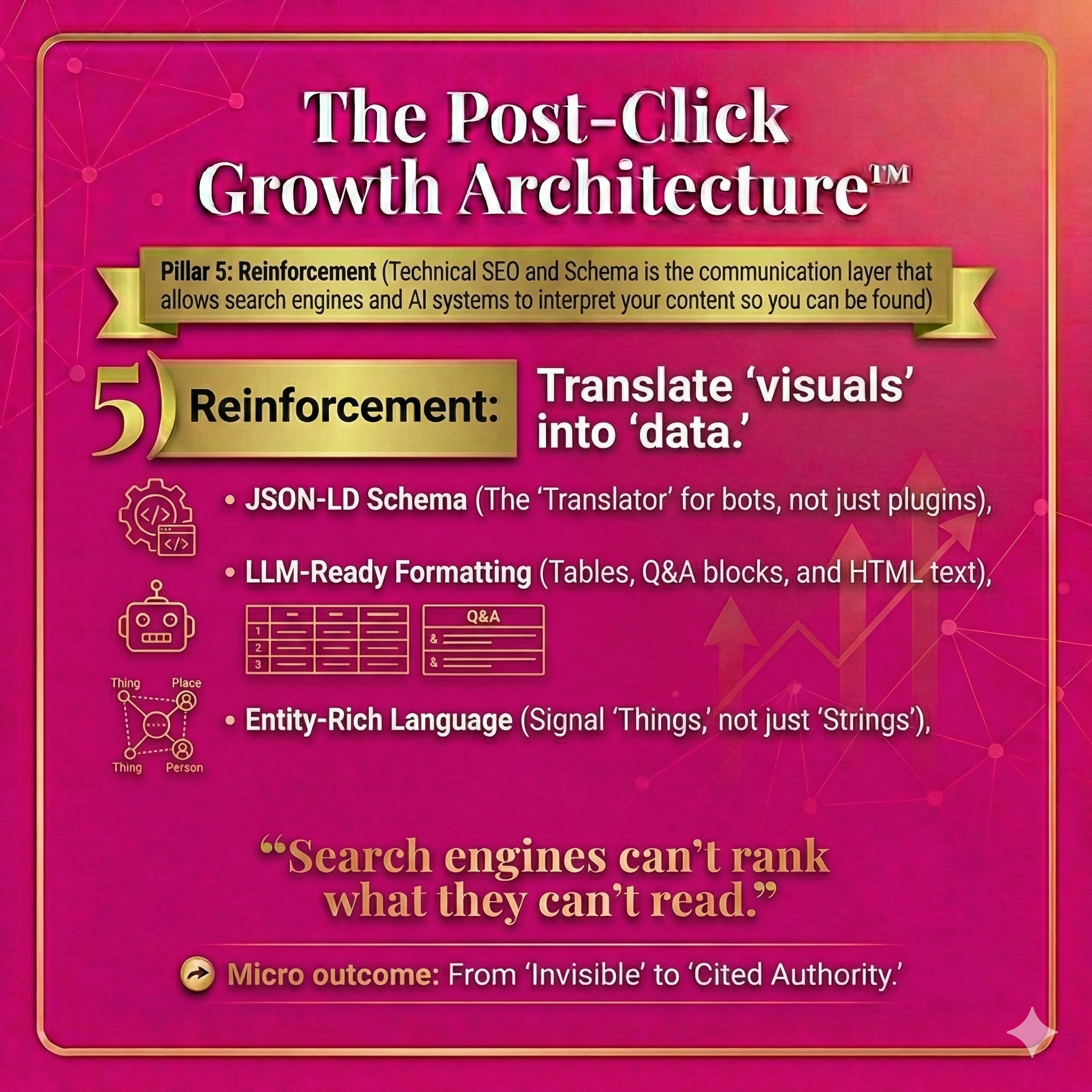
Pillar 5: Reinforcement
Technical SEO + Schema = the “Communication Layer”
It’s common for small businesses to create content and call it a day. They don’t realize they have a readability problem (for crawlers and AI). Reinforcement is the pillar that makes your content legible: if AI can’t clearly find, understand, and interpret your information cleanly, it can’t cite you, and search engines can’t confidently rank you as the authority.
This is where your foundation does the heavy lifting: discoverable pages (clean structure), internal linking that proves what your site is about, and formatting that’s easy to extract (clear sections, Q&A blocks, comparisons, tight bullet “quick answers”).
Then comes the accelerant: schema, your machine translator. When you map structured data intentionally (Product, CollectionPage, FAQPage, Breadcrumb, Article), you reduce ambiguity and help systems interpret what each page is and how it connects in your “hub → spokes” ecosystem.
Key Insight: Technical SEO isn’t “new SEO for AI”, it’s Architectural Reinforcement: the translation layer that turns your expertise into content search engines and AI can reliably parse, quote, and reuse.
👉 READ THE DEEP DIVE: Technical SEO is the Reinforcement, Making Your Site Easier to Read and Quote