

Technical SEO is the Reinforcement, Making Your Site Easier to Read and Quote
Technical SEO isn’t “new SEO” for AI, it’s reinforcement. It’s the communication layer between your content and the crawlers (and AI tools) trying to read it. If AI can’t clearly find, understand, and copy your information, it can’t cite you. The good news: most of what earns AI citations is the same foundation you already need, clean discovery + clear structure, with a shift toward quotable formatting and entity clarity.
This is where we get into the weeds a bit. Let’s say you’ve followed the guidelines mapped out in my other pillars of the Post Click Architecture for creating your content. Technical SEO is the communication layer between your content and the crawlers who interpret it.
If you’re a small business owner, here’s the simplest truth:
AI tools can only cite what they can clearly find, understand, and copy cleanly. So “technical SEO for AI citations” is mostly the same foundation you already need, just with extra attention on clarity and clean, quotable page structure.
In my framework, this is Architectural Reinforcement: treating technical SEO like a translation layer so search engines and AI systems can read, parse, and cite your site as an authority.
What stays the same with SEO and AI Citations (the “entry ticket”)
1) Your pages must be discoverable
If your site’s structure is messy, pages can get missed. In my audit example for Bohemi, only 68 out of ~650 pages were being crawled. After fixing the sitemap and internal structure, the number of successfully crawled pages increased to 740.
Plain-English translation: If Google/AI can’t reliably find your pages, they can’t cite them.
2) Internal linking is how your site “proves” what it’s about
Using my hub-and-spoke approach: a “pillar page” (hub) links to supporting pages (spokes), and those pages link back, creating a connected web that reinforces authority.
Plain-English translation: Your pages should “introduce” each other, so bots understand the full story, not random standalone posts.
Where the emphasis shifts for AI citations (without getting technical)
1) Clean, quotable formatting matters more than “perfect keywords”
AI loves clear sections, tables, comparisons, and Q&A blocks because they’re easy to extract and reuse. This thinking applies to your human visitors, too. Think about the last time you visited a website only to be met with a wall of text. This can be overwhelming for the brain, which then needs to parse the content to extract the most relevant information. Rather than sticking around to do so, your visitor will usually bounce.
2) Say what the “thing” is in plain language
Intentionally weave a few related entity terms (examples like product type + materials + brand names) so algorithms understand the thing you’re talking about, not just a keyword phrase. Use conversational language that is appealing to both humans and robots.
3) Structured data (schema) is your “machine translator”
You don’t always rely on default platform output, map schema intentionally (especially for collections, FAQs, educational content) using a “schema workbook” approach, and you prioritize schema types like Product, CollectionPage, FAQPage, Breadcrumb, and Article. Learn more about schema and why it matters to you in my blog post.
Easy, actionable tasks a non-technical small business owner can do
5-minute tasks (do 1–2 today)
Task 1: Fix “text trapped in images.”
If you have banners or Canva-style graphics with important info (shipping, sizing, materials), make sure the same key info also exists as real page text underneath. AI can’t read “pretty text” inside images the way humans do. Always name your image files appropriately and include alt text.
Task 2: Add a “Quick Answers” section to your top pages.
On your best-selling product page or a key collection page, add a short block like:
Materials
Sizing/fit
Shipping timeframe
Returns
Care tips
Use bullets. Keep it tight. This creates “copy-ready” chunks that AI can easily lift from your page.
Task 3: Add 3–5 “identity words” to your Home page, product descriptions, and pillar pages.
This is your entity clarity in human language. This is one of the foundational pieces that must be present throughout your website's content.
Example pattern:
[Brand] makes [product type] in [metal/material] with [gemstone], designed for [use-case].
15-minute tasks (do this once a week)
Task 4: Build one “hub → spokes” link set.
Pick ONE topic you want to be known for (ex: “opal jewelry,” “alternative engagement rings,” “no piercing required earrings”).
On your main guide/collection page (hub), add links to:
2–4 relevant products
1 FAQ page (or a simple FAQ section on that hub page)
1 educational post (care, sizing, stone meaning, etc.)
Then, on each spoke page, add a simple anchor text:
“Explore the full [Topic] guide/collection → [link].”
Task 5: Add a mini Q&A block to one page.
Add 3 questions as headings (exactly how customers ask), then answer in 1–3 sentences.
Example:
“Is this safe for sensitive skin?”
“Will the gemstone look different in different lighting?”
“How do I clean it?”
This directly matches your “Q&A blocks for extractability” approach.
1-hour tasks (monthly “reinforcement session”)
Task 6: Create a navigation path with your URL when you create a new page.
Use simple, readable URLs (not random strings). Make sure you use a clean URL structure so crawlers can see a logical hierarchy. Here’s an example:
www.yourdomain/pastel-gemstone-jewelry/shop/earrings/opal
Task 7: Do a “schema coverage check” (no coding required).
You can do this without touching code:
Make sure your platform has basics enabled (Product info, breadcrumbs if available). Breadcrumbs use the same methodology for creating a clean URL navigation path, except these are present on the page to ease site exploration, while simultaneously helping search engines understand your site’s structure.
For FAQs and educational content, add real FAQ sections on-page (even if you don’t add schema yourself yet).
The larger system is a schema workbook + intentional schema mapping, but this step still improves clarity immediately.
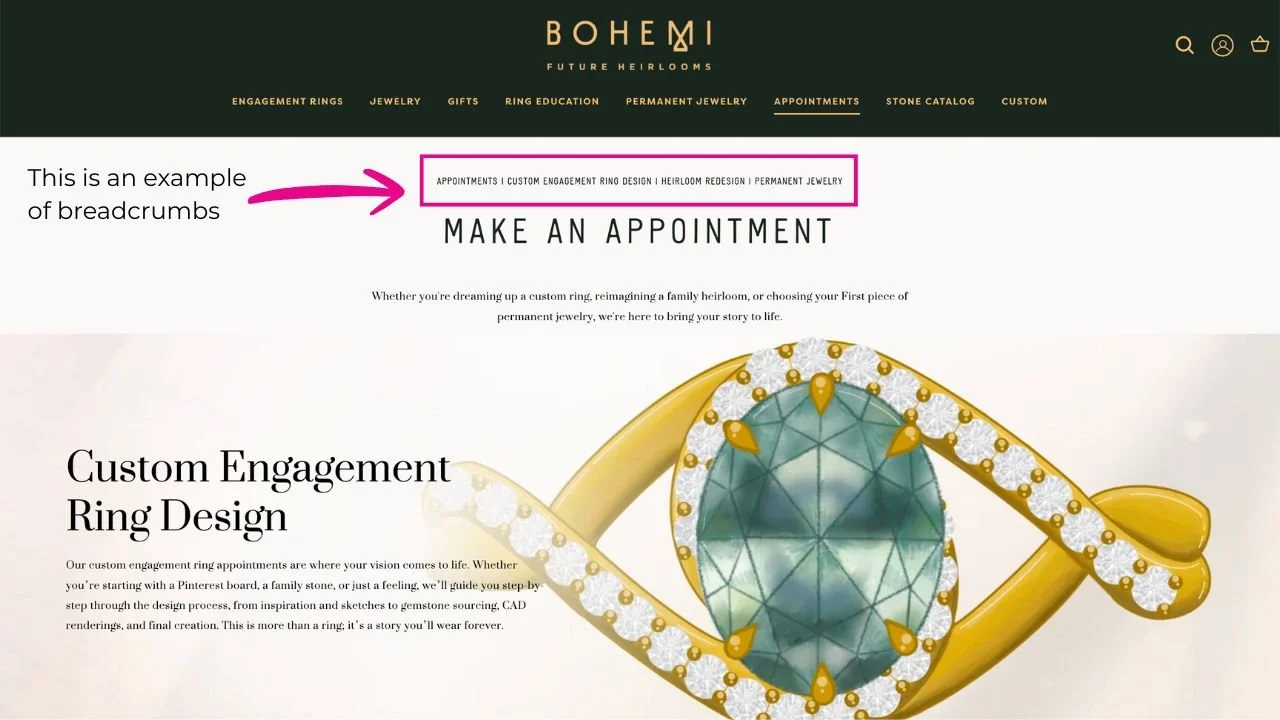
Task 8: Turn one helpful tool into a “citation asset.”
If you have anything interactive (a sizing guide, pricing explainer, “choose your metal” guide), add a short explanatory section around it:
What it helps with
How to use it
What to do next
These interactive tools, such as calculators/style quizzes, can become “content hubs” when they include structured explanatory copy that AI can cite. You can improve the clarity of your crawler tool by assigning the appropriate schema.
The simplest way to think about it
You’re not trying to “hack AI.” These are tried-and-true strategies of traditional SEO that are considered best practices. Except that, in the age of AI, these are no longer nice-to-haves; they are necessary. I will never tell you how to ‘game’ the system because those trends are not sustainable. You may get a temporary lift by deploying the latest hack, but Google is always updating its algorithms in order not reward sites that deploy ‘gaming’ strategies.
Instead, you’re making your website:
Easy to find (crawlable structure + internal links)
Easy to understand (clear entities + real text)
Easy to quote (modules, Q&A, tables, comparison blocks)
Ready to Fix Your "Reinforcement?"
Reinforcement is just one part of the puzzle. Even if you execute technical SEO and schema perfectly, you still need the architecture to guide them to a purchase.
If you are tired of guessing and want a site that is built to attract, interpret, and convert your ideal Search Personas automatically, you might be ready for a full system rebuild.
Apply for the Post-Click Growth Architecture™ Service. Turn your visibility into clarity, trust, and revenue.
Not ready for a full rebuild? Get access to my Pillar Page Upload Process with Video Walkthroughs in the Substack Premium Tool library.