

The “Digital Concierge” Advantage: How Interactive Tools Boost AI Visibility, Google Rankings, and Jewelry Sales
Interactive tools turn your jewelry website into a 24/7 digital concierge, a “salesperson” that helps shoppers self-qualify, feel confident, and take the next step. Jewelry buyers aren’t just searching; they’re comparing, second-guessing, trying to visualize, and worrying about price. Tools like pricing calculators, style-match quizzes, and metal selectors reduce friction (price uncertainty + decision paralysis) by giving shoppers clear answers without pressure. The visibility bonus: interactive content can boost Google rankings and AI citation likelihood because it increases engagement, proves expertise through structured workflows, and creates link-worthy assets others reference.
One of the best ways you can turn your website into a 24/7 salesperson working on your behalf is to include tools that can help self-qualify website visitors. interactive tools are the momentum that helps shoppers move.
“The biggest change I notice day to day is how much the website now supports my conversations with clients. I can use it as a real working tool—especially when talking with clients who are out of state or overseas.”
For jewelry designers, that matters because your buyers aren’t just searching, they’re comparing, second-guessing, trying to visualize, and worrying about price. A well-built tool answers the repetitive questions and guides decisions without pressure.
Yes, interactive tools create fun and engaging experiences, but they operate as so much more. They’re functional logic gates designed to reduce friction (price uncertainty, decision paralysis) and help shoppers access the information they need to make informed decisions.
And here’s the visibility bonus: interactive content can amplify both traditional SEO and AI citation likelihood because it boosts engagement, proves expertise through structured workflows, and creates assets other sites want to reference. [1]
Why interactive tools matter so much for jewelry brands right now
“In AI Mode, buyers often use a shortlist synthesis to shortcut the cognitive effort of Standard Searching and comparing. This raises the value of onsite decision assets...that provide AI with clear trade-offs, specific evidence, and sufficient contextual structure to describe a brand’s offering with confidence.”
1) Tools turn your expertise into “evidence,” not just marketing
A blog post can say you’re an expert. A tool tailors your expertise to the visitor.
That’s why my approach works: tools like a Ring Pricing Calculator codify real decision logic (metal choice, stone type, design complexity) into a workflow shoppers can follow and get immediate information and guidance.
This kind of structured, step-based experience is exactly what AI systems can extract and reuse when building answers, clear steps, definitions, tradeoffs, and “what to do next.” [2]
2) Tools increase “stickiness” (and that supports rankings)
Interactive experiences naturally increase time on page and depth because people engage, then click to explore recommendations rather than hitting a dead end. That aligns with broader SEO research showing interactive content tends to strengthen engagement signals and reduce bounce.[3]
3) Tools earn backlinks and mentions because they’re harder to copy
A competitor can rewrite your “metal guide.” They can’t easily replicate your exact calculator logic, your style-match flow, your output recommendations, or your UX.
That’s why interactive tools are naturally link-worthy; people cite them as resources, which reinforces authority for both classic search and AI surfaces. [4]
This is exactly the “proof of E-E-A-T” effect: your expertise becomes visible and operational, not just claimed.
4) Tools generate first-party data you can use to sell smarter
Quizzes, selectors, and calculators reveal what shoppers actually care about (budget comfort zone, style preferences, metal concerns, gemstone questions). That’s gold for improving your product pages, your FAQs, and your topic clusters, and it supports the broader “personalization + intent” direction I’ve been talking about throughout my Post Click Architecture.[5]
5. Tools tap into psychological triggers
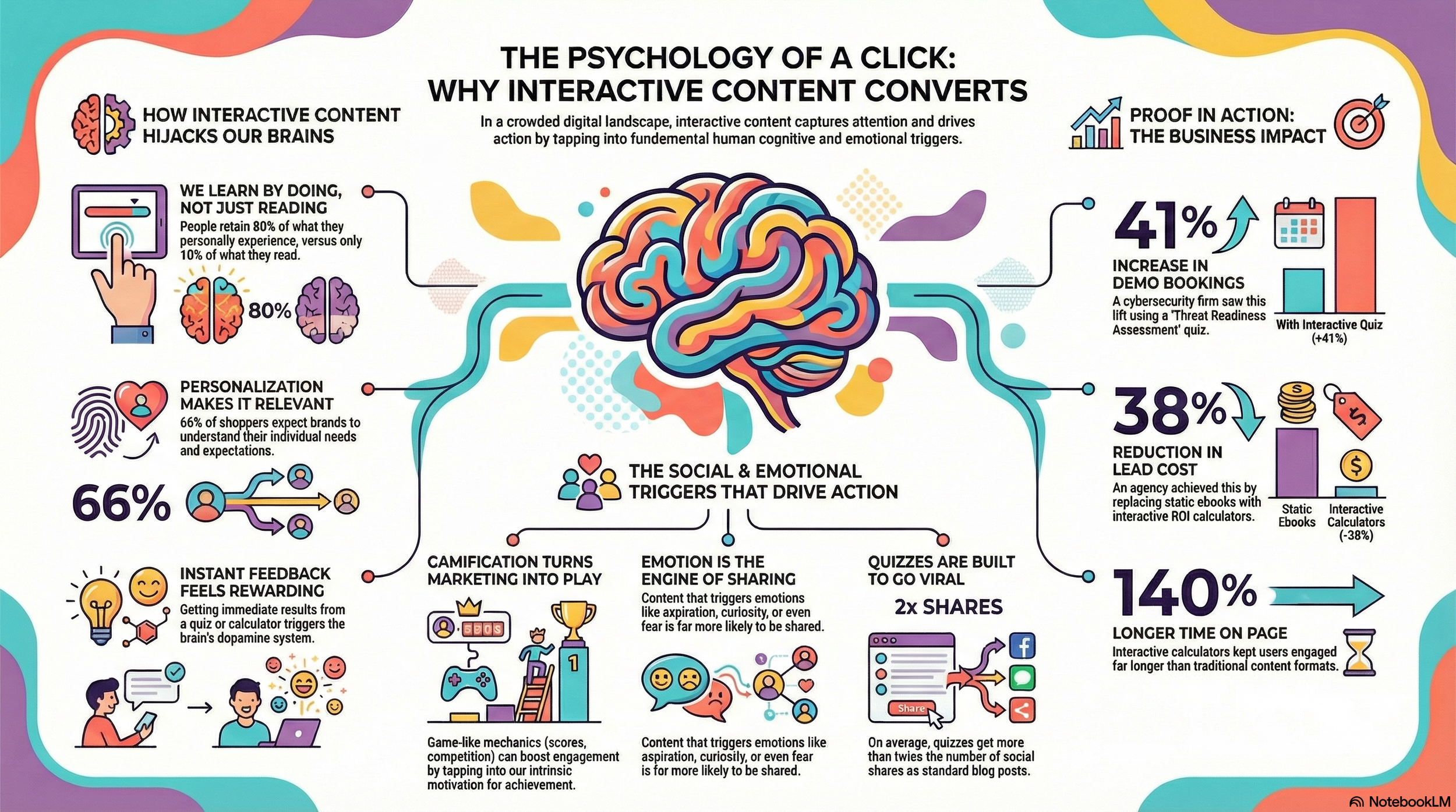
These tools also tap into psychological drivers like curiosity, self-discovery, and autonomy, which increase the likelihood of a return visit ("Return Intent") even if the user does not buy immediately.
How custom tools and SEO reinforce each other (the flywheel)
Here’s the flywheel you’re building:
The tool becomes a centerpiece asset
Surround it with supporting guides, FAQs, and comparisons (topic cluster)
Everything links together (hub-and-spoke)
Engagement improves (people stay longer, click deeper)
Mentions + backlinks increase because your tool is uniquely useful
Authority rises → you show up more → your tool gets used more → repeat
This is why interactive content is such a strong play in 2026 and beyond environments: it simultaneously supports visibility and conversion.
The “Digital Concierge” tool inspo for jewelry designers
To get the most bang for your buck, I recommend identifying real and common buyer friction points. Here are some examples to inspire your brand:
Price uncertainty → calculators that create confidence
Ring Pricing Calculator (models tradeoffs before a consult)
Affirm/payment estimator or metal scrap credit calculator (self-qualification for financing)
Analysis paralysis → style match tools that narrow the field
“Find Your Ring Match” with clickable persona cards (Witchy/Boho/Geometric) that move someone from “I like this vibe” to a curated collection based on their preferences.
Preference uncertainty → selectors that help people visualize
Metal Selector that helps shoppers visualize tones/finishes like an in-store try-on experience.
These tools don’t replace your storytelling; they organize it into actionable decisions.
Why tools work even better when paired with your “Reinforcement” pillar
This is the part most small businesses miss: they add a tool… but the site architecture doesn’t help search engines (or AI) interpret it.
In my framework, technical SEO is a translation layer that ensures crawlers and LLMs can read, parse, and cite you. So you don’t treat tools like widgets, you treat them like SEO assets:
You build them with custom HTML/CSS/JS so they match the brand system (and aren’t limited by plugin constraints).
You add custom schema so the logic and purpose of the tool is machine-readable (so AI can confidently understand “what this is”).
You surround the tool with structured explanatory copy (headings, bullets, scannable segments) to create clean, extractable “answer chunks.”
You connect tools to hub-and-spoke internal linking on pillar pages so authority flows and topical depth are obvious.
That pairing, reinforcement + interactive momentum, is what makes a tool become a citation asset.
How to practically plan and prioritize
Step 1: Nail your foundations first
Before you build the tool, make sure AI and search can actually access and interpret your site:
clean crawlability + structure
internal linking pathways
real HTML text (not key info trapped inside images)
clear entities (brand + product type + materials + stone + use-case)
schema strategy (even basic coverage helps)
Step 2: Build one flagship tool around a high-stakes decision
Pick the point where buyers stall the most:
“How much will this cost?” → pricing calculator
“What style am I?” → style match quiz
“Which metal is right for me?” → metal selector + care guidance
“Will this irritate my skin?” → sensitive-skin recommender + FAQ
Interactive content is emerging as a strong differentiator in AI-driven search because it’s useful, structured, and engagement-rich. [6]
Step 3: Wrap the tool in a topic cluster so it becomes the centerpiece asset
Publish supporting pages that all link to the tool and to each other:
“How the calculator works” (simple explanation + examples)
FAQs (objections + reassurance)
comparisons (14k vs 18k, platinum vs gold, lab vs natural, etc.)
product/collection spokes that match the tool product recommendations
A quick example you can steal: turning a tool into an “AI-citable workflow”
Imagine a Ring Budget Clarity Tool that walks shoppers through:
Budget → priorities (size vs setting) → metal choice → stone type → recommended ranges → matching collections → book consult
That’s exactly how LLMs “think” when summarizing: step-by-step, tradeoffs, clear outputs, which makes your tool a clean input for AI answers. [7]
Closing: this is how you win in a saturated, AI-flooded niche
When the internet is flooded with generic, samey content, tools are defensible. They’re harder to copy, more valuable to users, more likely to earn mentions, and easier for AI systems to extract into answers. [8] Remember, search engines and AI systems prefer information that adds something new to the conversation and look for content that provides substantial value compared to other pages in search results.
If you want a website that attracts the right shoppers and guides them to purchase, build it like this:
Reinforcement: make your site easy to find, understand, and quote.
Digital Concierge tools: make it easy for buyers to decide, self-qualify, and take the next step.
Ready to Fix Your "Decision Pathways?"
Interactive tools are just one part of the puzzle. Even if you execute them perfectly, you still need the architecture to guide them to a purchase.
If you are tired of guessing and want a site that is built to attract, interpret, and convert your ideal Search Personas automatically, you might be ready for a full system rebuild.
Apply for the Post-Click Growth Architecture™ Service. Turn your visibility into clarity, trust, and revenue.
Not ready for a full rebuild? Read about how I implemented these tools for Bohemi. Read my case study Transforming a Local Jewelry Brand Into an AI-Search-Ready Engagement Ring Destination.
Frequently Asked Questions
What is a digital concierge tool for a jewelry website?
How do interactive tools improve AI visibility?
Do I need to be a developer to add interactive tools to my jewelry site?
Want Red Pin Geek in Your AI Answers?
Google now lets you choose preferred sources that get labeled in AI Overviews and AI Mode. If this content helps you navigate AI visibility for your jewelry business, add us and you'll spot our links faster next time Google answers your questions.
Add Red Pin Geek as a Preferred SourceTakes one click. Works in Google Search, AI Overviews, and AI Mode.